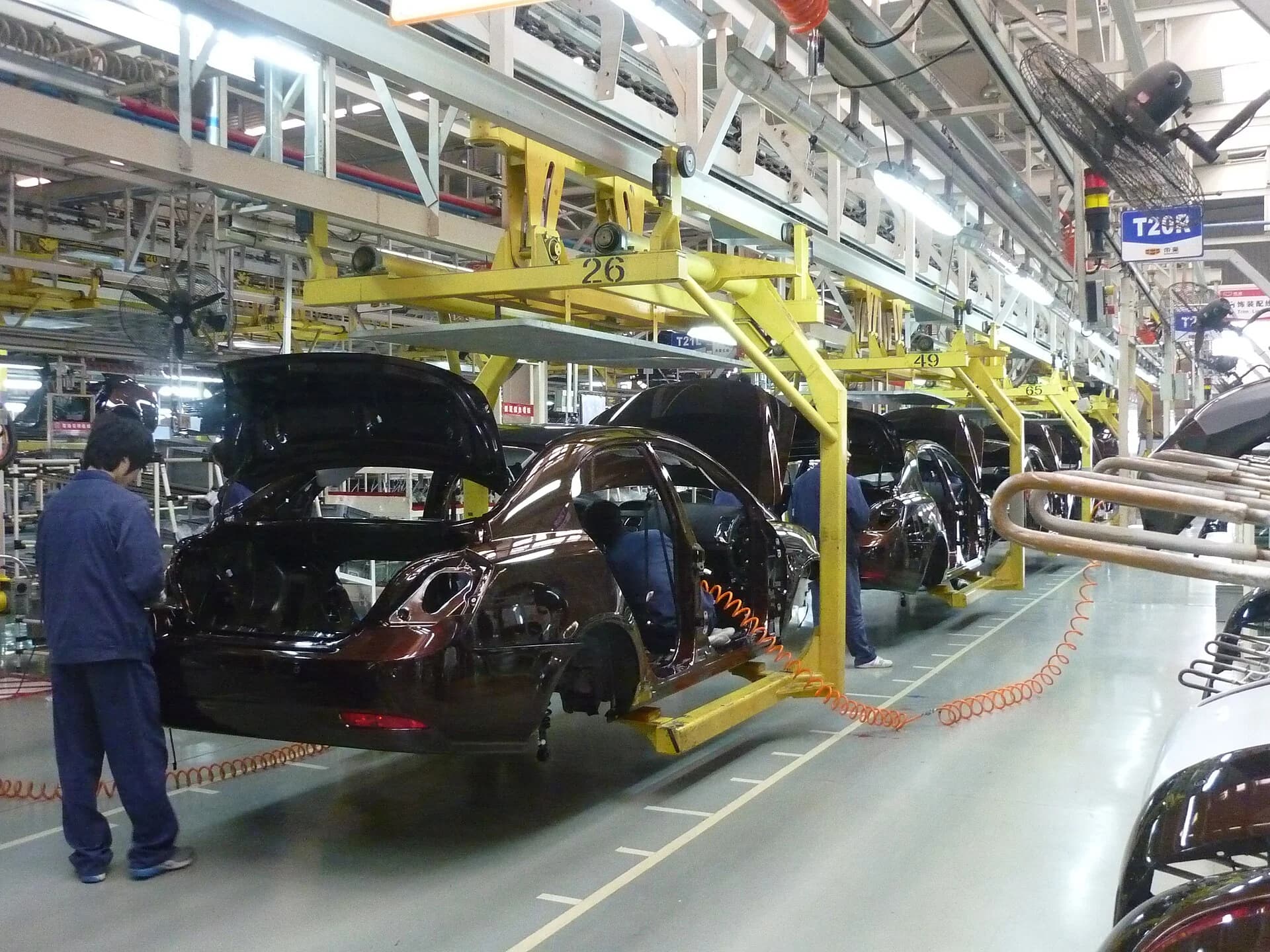
Geely Auto cuts domestic capacity while launching EV production in Brazil
Chairman Li Shufu announced a full operational restructuring at the Chongqing Auto Show, targeting closure, suspension, merger, or divestiture of redundant facilities.

French authorities fine Shein €22 million across four violation categories
French regulators announced two new fines totalling over €22 million (US$25.4 million) against Shein on June 3, covering product traceability, environmental information, return rights, and delivery times.

China summons eight EV makers over OTA battery locking practices
Chinese regulators have summoned eight electric vehicle manufacturers over the use of over-the-air software updates to lock battery capacity without consumer knowledge.

China issues 79-article framework to secure critical mineral supply chain
Premier Li Qiang has promulgated 79 implementing regulations under China's revised mineral resources law, taking effect June 15. The framework spans mining, processing, utilisation, and stockpiling in a single coordinated instrument — covering rare earths and other critical minerals explicitly.

China's Pinglu Canal set to open earlier than expected
Construction on the 134km (83-mile) Pinglu Canal linking Nanning to the Gulf of Tonkin has entered its final phase, with trial operations now expected as early as September — ahead of the previously anticipated schedule.

BYD launches China's first 4nm autonomous driving chip
BYD has unveiled the Xuanji A3, a 4nm autonomous driving chip delivering 700 TOPS of computing power and designed to support Level 3 and Level 4 autonomy.

BYD launches "flash-charging" model and expands global charging network
BYD is bringing a premium hybrid SUV to market with flash-charging technology that adds 400 km of range in 5 minutes, priced at 350,000 yuan.

New energy vehicles now account for 56.9% of all new car sales in China
New energy vehicles now account for 56.9% of all new car sales in China, with 1.496 million units sold in May 2024 — a 14.4% year-on-year increase. Traditional combustion engine passenger vehicle sales fell 41.

Alibaba launches first AI model suite for robots through Tongyi Lab
Alibaba's Tongyi Lab has released the Qwen Robot Suite, the company's first purpose-built set of AI models for robotic applications.

Beijing gives local governments and SOEs less than six months to prove humanoid robots work
China has launched a nationwide programme to push humanoid robots and embodied AI into factories, warehouses, and hospitals. Local governments and state-owned enterprises have been given a sub-six-month window to demonstrate the technology's viability in real operational settings.

Chinese universities cut 12,000 degree programmes to meet AI era demand
Beijing has eliminated roughly 12,000 degree programmes from Chinese universities since 2021, replacing them with technology-focused courses aligned to state-designated 'future industries'.

China Southern completes first C919 C-check as European regulators watch
China Southern Airlines finished the first C-check of its C919 fleet at the end of May, 3 years after the aircraft entered commercial service with China Eastern Airlines.

SAIC Motor to build first European EV plant in Galicia, Spain
The Galicia regional government has announced that SAIC Motor will invest €200 million to build its first electric vehicle manufacturing plant in Europe, creating more than 2,300 local jobs. Chinese automakers are shifting production capacity westward as domestic sales fall sharply.

Baidu Apollo Go secures Level 4 robotaxi permit in Switzerland with PostBus
Baidu's Apollo Go has received a Level 4 autonomous driving permit from Swiss federal regulators to operate its AmiGo robotaxi service across 80 km² in eastern Switzerland.

China NEV Penetration Hits Record 62.5% as Infrastructure Buildout Accelerates Recovery
China's NEV market is pushing toward a record 62.5% retail penetration rate in May, even as year-on-year sales volumes remain negative—a divergence that reveals a structural shift rather than a cyclical rebound.
China and US Chip Makers Split on How to Scale AI Silicon
Two parallel chip strategies are hardening simultaneously — Western players pushing panel-level packaging for efficiency gains, while Chinese firms race to architect their way around sanctions — and both movements produced concrete hardware announcements in the same week.

Yuan's Parallel Financial Architecture Gains Credibility Across Five Fronts Simultaneously
Citic Securities became the first mainland Chinese brokerage to breach Fitch's A-category ceiling, while Ant International embedded Chinese fintech infrastructure into Mexico's payment system — two events that, taken together, signal Beijing's yuan internationalisation push is graduating from…

Chinese Firms Execute Coordinated Westward Push Across Auto, Tech, and Finance
SAIC Motor confirmed a €200 million EV plant in Galicia, Spain, Xpeng began delivering its flagship X9 MPV across seven European countries, and Baidu's Apollo Go secured a Level 4 robotaxi permit in Switzerland—all within days of each other, marking the most concentrated week of Chinese outbound…

Chinese Automakers Bifurcate Strategy as Domestic Market Contracts 20%
NIO CEO William Li told the China Auto Chongqing Forum that domestic passenger vehicle retail sales have already fallen 19.

China's Physical AI Ecosystem Shifts From Model Competition to Embodied Deployment
Tianjin's robotics cluster quietly swept a Beijing half-marathon competition while Zhiyuan Robotics crossed 10,000 units in mass production and Baidu's Create 2026 declared the AI industry has moved from model capability to agent task execution—three simultaneous signals that China's physical AI…

China's AI-Energy Integration Doctrine Locks In Vertical Control Across Critical Chains
Beijing's NDRC, NEA, MIIT, and National Data Bureau jointly released an action plan this week mandating 29 specific tasks to couple AI computing infrastructure directly with renewable energy supply — a policy move that transforms what looked like parallel industrial strategies into a single,…

China Telecom's Token Plans Signal Commoditization Trap Across AI Sector
China Telecom's nationwide launch of AI token subscription plans—priced from 9.9 yuan per month for casual users to 299.

Baidu's AI Revenue Milestone Masks a Monetization Gap Threatening China's Tech Giants
Baidu crossed a structural threshold in Q1 2026—AI businesses now account for more than half of revenue—yet total income fell 2%, exposing the core tension accelerating across China's major platforms: AI investment is replacing legacy revenue faster than it generates new profit.

China's Volume-Over-Profit Trap Pushes Firms Toward Forced Global Expansion
April retail sales grew just 0.2% year-on-year — a collapse from March's 1.7% and well below the 2% forecast — confirming that the domestic demand floor supporting China's volume-expansion strategy has given way precisely as corporate margins across five industry verticals hit critical lows.

Beijing Treats AI Computing Power as a Public Utility, Reshaping Infrastructure Investment
China's state media is now explicitly framing AI computing capacity as national infrastructure on par with power grids and water networks—a framing that signals accelerating government capital deployment into data centers, energy storage, and computing networks that will reshape supplier and…

China's EV Tech Stack Collapses Downmarket as Robotaxis Enter Mass Production
XPeng became China's first automaker to roll a mass-produced robotaxi off the line this week, while BYD validated 9-minute flash charging for mass deployment and Svolt set September as its target for hybrid solid-liquid batteries at liquid-cell costs—three simultaneous capability thresholds crossed…

Baidu's AI Revenue Milestone Signals Fracturing of Western AI Infrastructure Control
Baidu's Q1 2026 results confirm AI business now exceeds half of general revenue—¥13.6 billion of ¥26 billion—while Microsoft has shed 24% of its market value since October 2025, underperforming the Nasdaq by 35 points over six months.

Chinese Big Tech Rewrites Hiring Rules as AI Absorbs Entry-Level Work
China's major tech firms have structurally reorganized their hiring criteria around AI capability — not as a preference, but as a baseline — and the velocity of that shift is compressing years of workforce transition into a single recruitment cycle.

China's Hybrid Battery Bridge Strategy Moves From Lab to Assembly Line
Svolt Energy will begin mass-producing hybrid solid-liquid batteries by September at cost parity with conventional liquid lithium-ion cells — a commercialization threshold the broader Chinese battery industry has been building toward for months.

China's GPU-Free Supercomputer Signals a Deliberate Domestic Chip Strategy
China's National Supercomputing Center in Shenzhen has deployed LineShine, a 2.45 million CPU-core supercomputer built entirely on domestic Armv9-based LX2 processors—no GPUs, no foreign silicon. The architecture is not a technical compromise; it is a policy statement.

China's EV Technology Stack Widens Its Lead Over Western Rivals Weekly
BYD this week validated 9-minute flash charging across 1,000 full cycles without battery degradation, while Xiaomi's YU7 GT broke the Nürburgring SUV lap record—two developments that, taken together, signal Chinese EV makers are closing the last remaining performance gaps that Western buyers use to…

Changan's ADAS Rejection Signals China OEMs Closing Doors on Third-Party Smart Driving
Changan Auto has publicly denied reports it planned to adopt Qianli Technology's advanced driver-assistance system or take an equity stake in the company — a denial that reveals more about Chinese OEM platform strategy than any partnership announcement would have.

China's AI-Energy Integration Doctrine Locks In Vertical Control Across Critical Chains
Beijing's NDRC, NEA, MIIT, and National Data Bureau jointly released an action plan this week mandating 29 specific tasks to couple AI computing infrastructure directly with renewable energy supply — a policy move that transforms what looked like parallel industrial strategies into a single,…

China's Physical AI Push Locks In Supply Chains, Manufacturing, and Export Dominance
Beijing's manufacturing consolidation strategy is now visible across five simultaneous vectors—robotics, autonomous vehicles, European plant acquisition, cross-border logistics, and party-level policy reinforcement—all accelerating in the same three-week window.

China's Big Tech Profits Collapse as AI Spending Race Accelerates
Alibaba's Q4 adjusted EBITA fell 84% year-on-year while Tencent missed Q1 revenue estimates — both companies simultaneously pledging to accelerate AI capital expenditure beyond already-elevated targets, crystallizing a structural tension that is now visibly bleeding into equity valuations.

BYD's European Factory Push Signals Shift From Exporter to Local Manufacturer
BYD executive vice president Stella Li confirmed this week that the company is in active talks with Stellantis and multiple other European automakers to independently acquire and operate underutilized assembly plants—a move that, combined with a simultaneous technology upgrade blitz, marks a…

Beijing Coordinates Nuclear, EV, and Grid Robotics Into a Single Energy Security Doctrine
EXECUTIVE SUMMARY China's energy security strategy has shifted from reactive stockpiling to coordinated structural transformation, triggered by the Strait of Hormuz crisis and accelerating U.S. sanctions pressure.

Beijing Auto Show Confirms China's Full-Stack EV and AI Industrial Surge
The 2026 Beijing Auto Show delivered the clearest single-week evidence yet that China's advanced manufacturing push has moved from policy document to commercial reality — with autonomous driving, battery technology, and physical AI converging across consumer and industrial markets simultaneously.

China's E-Bike Giants Face Structural Margin Collapse Beyond Cyclical Pressure
Aima Technology's Q1 net profit fell 67.57% on an 18.45% revenue decline — a ratio of margin destruction to revenue loss that signals something more serious than a demand slowdown affecting China's electric two-wheeler sector.

China Turns Hormuz Shock Into a Mineral and Supply Chain Power Play
Beijing is simultaneously hardening its supply chain defenses and tightening its grip on critical mineral exports, using the ongoing US-Israel war on Iran as both a threat to manage and an opportunity to exploit.

China's AI Ecosystem Closes the Loop on Domestic Hardware-Software Integration
China's AI sector completed a visible circuit this week: DeepSeek V4 became the default model for a global open-source agent framework, Xiaomi's 3nm chip crossed one million shipments, and Beijing blocked Meta's Manus acquisition—three moves that, read together, signal a deliberate transition from…

Chinese Banks Formalize Satellite Surveillance of Loan Collateral as State Standards Arrive
China's release of its first commercial space standard system on April 24 hands its banking sector a regulatory backbone it was missing — converting what began as ad hoc satellite credit monitoring into a codified, scalable industry practice.

U.S. Sanctions Hit Hengli Petrochemical's Core Refining Subsidiary Over Iran Oil
Washington has placed Hengli Refining and Chemical Co., Ltd. (Dalian), the core wholly-owned subsidiary of A-share listed Hengli Petrochemical (600346.SH), on the U.S.

Xpeng's VLA 2.0 and flagship GX SUV signal a credible recovery arc
Xpeng delivered 31,011 vehicles in April—up 13% month-on-month—while independent testing confirms its VLA 2.0 autonomous driving system now matches Tesla's Full Self-Driving performance in Chinese urban conditions, narrowing two competitive gaps simultaneously.

China Wires AI Into Steel, Roads, and Power Grids at Scale
Beijing's $14.7 trillion blueprint to fuse software with manufacturing moved from policy to product this week, with autonomous trucks, robotaxi production vehicles, maglev factory systems, and a $1 billion robot procurement plan for the power grid all surfacing simultaneously.

C919 Engine Crisis Exposes Supply Chain Fault Lines Beijing Can No Longer Ignore
China's Politburo convened last week to address external economic shocks—including energy security threats from the US-Israel war on Iran—and the policy response lands directly on the same industrial vulnerabilities that have left COMAC's C919 program delivering just three aircraft in Q1 2026.

Beijing's zombie crackdown accelerates e-bike shakeout as margins collapse
China's top market regulator has launched a forced-insolvency pilot across seven economic hubs—including Beijing, Guangdong, and Zhejiang—targeting subsidy-dependent firms for compulsory liquidation, a direct threat to the overcrowded electric two-wheeler sector already bleeding from its worst…

BYD and Xiaomi set new mass-market EV benchmarks at Beijing Auto Show
China's two most aggressive EV developers debuted hardware this week that resets expectations for what a sub-$32,000 electric vehicle can deliver—and the order numbers confirm the market is responding immediately.

China's State Council Wires Nuclear, Battery, and AI Into a Single Security Architecture
EXECUTIVE SUMMARY Beijing is not managing an energy transition — it is constructing a vertically integrated security architecture that runs from uranium to inference tokens.

BYD Files Permits for Third Moroccan Battery Plant in Six Months
BYD filed permits last week for a 4GWh LFP cell plant in Kenitra, its third Moroccan production filing since November. Combined planned capacity now sits at 9GWh.

Foxconn Diversifies Out of Zhengzhou Faster Than Apple's Public Timeline
Foxconn's capex disclosures show $1.4B committed to non-Chinese sites in the past nine months — Tamil Nadu, Vietnam, and a quietly disclosed Mexico expansion.

LFP Cell Spot Prices Drop Below $58/kWh — First Time on Record
CATL, EVE, and Gotion all quoted LFP cell spot prices below $58/kWh on Chinese B2B exchanges this week. Twelve months ago the floor was $89.

DeepSeek's Enterprise API Pricing Undercuts OpenAI by 92% on Comparable Tasks
DeepSeek published enterprise API tier pricing this week: $0.14 per million input tokens, $0.28 per million output. The same workload on GPT-4o costs roughly 11x more.

